
Floyd County Court Docket Searches
Tracking a Superior civil or criminal case in Floyd County? The answer is the Floyd WebCaseManagement docket interface. The landing page gives you three choices: New Search, Civil Search, and Criminal Search. Search by case number, party information, or whichever fields the form offers. Found your case? Click the plus sign beside it. The docket then opens as an index and event history. It does not promise that every filed image is public, current, or free.
For county-level background, start elsewhere. The official Floyd County government site is the next stop.
County navigation helps you find the right court. The docket search itself, though, lives on the court-specific route.
Gather a few details before you search. Copy a few details from a citation, notice, summons, or prior filing. Include the court name, case number, party spelling, and filing-date range. Court identity matters in Floyd County. No single portal combines every local tribunal. A municipal citation, a Probate traffic matter, and a Superior felony sit with different custodians. All of them arose in the same county.
- Identify the court printed on the source document before choosing a portal.
- Open the Floyd docket form and choose civil, criminal, and the matching court category.
- Enter at least one criterion; entered text must contain at least three characters, excluding the percent sign.
- Expand the result and distinguish filings, settings, orders, and dispositions.
- Confirm a setting or request the actual document from the clerk that maintains the case.
Inside Floyd's Two Search Forms
Floyd County splits its search controls in two. The civil form asks for a case number, party name, CSE number, or a system-wide field. It also wants filed-from and filed-to dates. Its categories cover Superior Civil, State Civil, Domestic, Child Support, Habeas Corpus, and other listed civil groupings. The criminal form offers case number, name, alias, citation number, a system-wide field, filed dates, and court-category choices. Pick the narrowest category the case fits. That single habit cuts unrelated results from your docket search.
| Form | Useful fields | Local caution |
|---|---|---|
| Civil | Case, party, CSE, dates, category | State Civil is a portal category, not proof of a separate statewide search. |
| Criminal | Case, name, alias, citation, dates | A name match alone does not establish identity or outcome. |
| Both | System-wide text and filing dates | At least one criterion and three text characters are required. |
A valid search that returns nothing is not the end. Recheck the court category first. Then check the date range, the party spelling, and whether the case actually sits in a lower court before deciding no docket exists.
Court Dockets: What They Show
A Floyd County court docket lists the events the clerk has recorded for a case. Read the header first. Confirm the court and the case identifier. After that, treat each dated entry as its own filing, order, setting, or clerk action. Keep the limits in mind. A scheduled motion is not an order deciding that motion. A calendar appearance does not prove testimony occurred. When you need the exact language of a judgment, pleading, or directive, get the document itself. Do not trust the event label.
| Case Number | The court-assigned identifier used by the search form and case header; preserve it exactly. |
|---|---|
| Parties | Participants named in the case, subject to spelling, identity, and access limits. |
| Docket Entries / Filings | Dated events such as pleadings, service, motions, orders, and clerk actions. |
| Hearing Settings | Calendar placements that may show a date, time, judge, division, or setting label. |
| Court & Judge | The tribunal and judicial division responsible for the listed proceeding. |
| Disposition | A recorded procedural or final result, which should be checked against the filed order. |
Floyd County Calendar Labels in Plain Terms
Floyd Superior judge pages carry labels. Learn to recognize them. They include Civil Calendar, Criminal Non-Jury Calendar, Calendar Call, Arraignment Calendar, Plea Calendar, Status Calendar, Special Set Civil Calendar, Peremptory Calendar, and addendum. Each label describes the kind of setting or the way the calendar was posted. That is all it does. A label never states that a case ended. Nor does it show that a requested result was granted.
- Calendar call
- A setting used to call or organize matters for scheduling, trial, or another action.
- Addendum
- A supplement to an already posted calendar, not a replacement unless the court says so.
- Status calendar
- A case-status review or update, not itself a disposition.
- Special set
- A matter placed at a specially scheduled time under the judge's calendar.
Magistrate calendar files also carry MT, MD, MV, and PH codes in their official filenames. The court publishes no key for them. Preserve the codes as written and ask Magistrate Court directly what they mean instead of guessing.
Floyd County Courts and Their Dockets
Floyd County docket entries land in different offices. Georgia splits its trial courts into six classes. Superior Court holds the general-jurisdiction cases. But it is hardly the only custodian of court records. Magistrate, Probate, Juvenile, and the municipal courts each keep their own dockets. The local portal even lists State Court categories. No dedicated Floyd State Court page appears in the county's own navigation. No named custodian appears either. Ask court administration to confirm that category before relying on it for a docket search.
For jurisdiction and circuit context, turn to the Floyd County Superior Court overview. It lays out what that court covers.
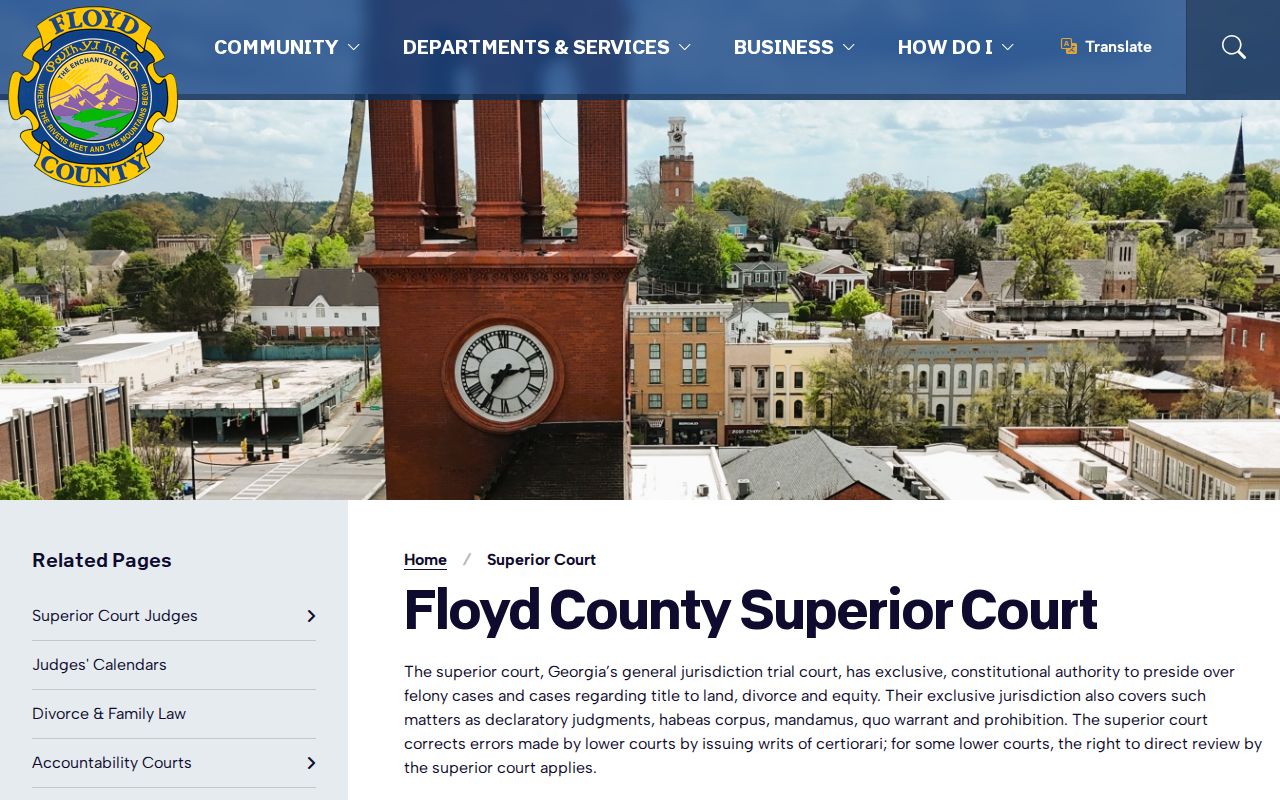
That overview helps you confirm a matter belongs to Superior Court before choosing a lower-court or city route.
| Court | Docket Covers | Where to Search |
|---|---|---|
| Floyd County Superior Court | Felonies, divorce, equity, land title, habeas, and general-jurisdiction matters | Floyd docket interface and Superior Clerk |
| Magistrate Court | Civil claims up to $15,000, dispossessory, garnishment, warrants, bonds, and preliminaries | Suite 227 clerk and Magistrate calendar center |
| Probate Court | Estates, wills, guardianships, licenses, and traffic outside city limits | Probate office and Georgia Probate Records |
| Juvenile Court | Delinquency, dependency, CHINS, and related juvenile matters | Juvenile Court office; public access is restricted |
| Rome and Cave Spring Municipal Courts | City citations, traffic, ordinance, and municipal matters | Each city's court and payment channels |
Local Floyd Search or Georgia E-Access?
Georgia Courts offers an E-Access Court Records directory, not one unrestricted statewide public docket. The Floyd Superior listing sends users to Tyler ResearchGA and says an account is required. That provider route is separate from Floyd's visible public WebCaseManagement forms. The two layers do different jobs. The local interface exposes docket search controls. The directory instead routes users to a participating provider for court-record access.
Odyssey eFileGA and Peach Court are separate too. Georgia lists them as mandatory filing providers for Floyd Superior civil filings. GreenFiling and InfoTrack are also available. Filing a document is not the same as searching a public index. It is also not the same as receiving a certified copy. Do not create a filing account just to read a setting. Start with the local docket. Move to the provider only when its access layer is needed. Then rely on the Superior Clerk for an authoritative copy.
Court Dates and Settings in Floyd County
Superior Court posts judge-specific calendar links for Divisions One through Four. They cover civil, criminal, arraignment, plea, status, non-jury, peremptory, and special-set files. Magistrate Court runs a searchable document center with dated PDFs. Probate traffic, Rome Municipal Court, and Cave Spring Municipal Court each publish their own day and time instructions. None of this appears on the county general-events calendar. So do not treat that calendar as a substitute.
A posted calendar is an official scheduling source. Still, a continuance, addendum, emergency order, or same-day change can affect it. Match the court, judge, file date, and label to your notice. Then use the Floyd County court schedule walkthrough. Confirm travel-sensitive details with the responsible office.
When Floyd County Operations Change
Two 2026 events show why a Floyd County docket search needs a current calendar check. A January winter-storm order closed the courthouse for a planned day. It continued civil and criminal matters and addressed applicable deadlines. Then a March Rome Circuit order followed a historic courthouse fire. Neither event changed the substance of any case. They did move access, hearings, and filing activity.
What should you do when an old notice conflicts with a newer calendar or emergency order? Keep both documents. Contact the court. A missing calendar entry does not mean dismissal. An emergency closure does not erase a deadline unless the controlling order says so. For current orders statewide, the Georgia judicial emergency order index is the place to look. The Floyd judge-calendar page remains the local scheduling source.
Docket Access Under Georgia Law
Georgia court records start from a presumption of public access. That presumption bends, though. A statute, rule, protective order, or case-specific sealing order can limit a document or field. So a record missing online is not proof it does not exist. Redactions may hide protected identifiers. Juvenile information stays confidential or restricted. Some exhibits need judicial approval to view. When the index does not answer the access question, ask the court. That court holds the file.
Key Rules:
Uniform Superior Court Rule 21 explains the public-access principle and the process for restricting access.
Georgia Open Records Act guide describes inspection, copying, exemptions, and protected material.
Georgia Open Government FAQ explains request methods, reasonable retrieval charges, redaction, and general copy guidance.
Floyd Dockets That Stay Restricted
Juvenile Court covers delinquency matters for children under seventeen. It also covers dependency, CHINS, juvenile traffic, emancipation, transfers, and related proceedings. All of it is confidential or access-restricted. Georgia's JDEX attorney system is one lawful route in. It is not a general public juvenile name search. Contact Juvenile Court for access guidance rather than working around the restriction.
Other Floyd County files can hold protected identifiers. Some fall under a sealing or access order. A public case header does not make every attached image public. By the same token, one missing image does not prove the whole case is sealed. Watch what the public interface actually shows. Avoid repeating sensitive identifiers. Ask whether a redacted or otherwise accessible copy can be provided.
How the Clerk Keeps Docket Records
Mary Hardin Thornton is the Clerk of Floyd Superior Court. Her office keeps the Superior civil and criminal dockets, along with pleadings, orders, judgments, and related court documents. Start with the online docket. When you need a copy or confirmation, move to the clerk by telephone, mail, or counter. Floyd's administrative County Clerk and its NextRequest portal handle county government records. Those are not automatically the court file. Probate, Magistrate, Juvenile, Rome, and Cave Spring records each stay with their own offices. The Floyd Superior Court Clerk's official site is the page to use for that office's docket services.
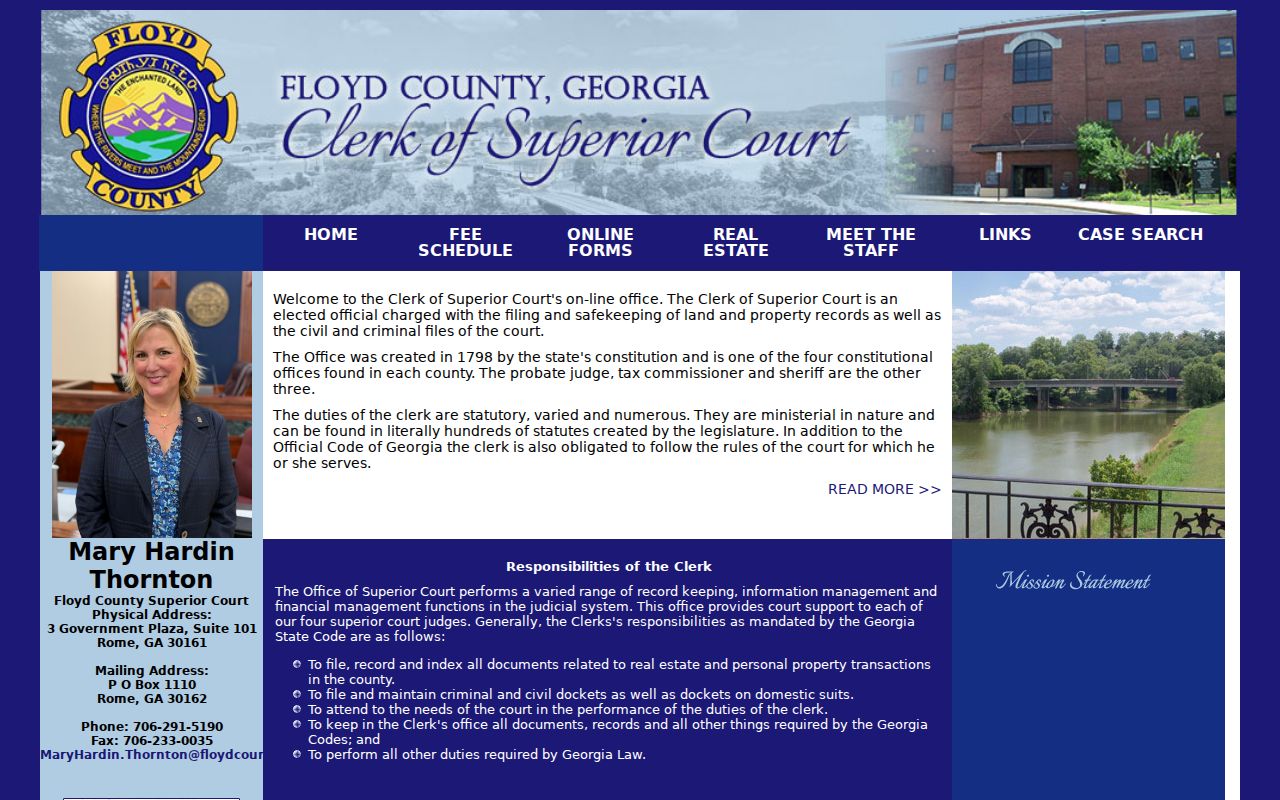
Send Superior docket documents and certification requests to that office. A court-file request routed to the county administrative clerk will only bounce back.
Floyd Superior Court Clerk
3 Government Plaza, Suite 101
Rome, GA 30161
Mail: PO Box 1110, Rome, GA 30162
706-291-5190
Docket Entry or Filed Floyd Record?
The docket is the event history. The case file holds the documents behind those events. An entry may say an order was entered. Only the filed order supplies its exact language. Floyd Superior's clerk offers plain copies, certifications, exemplified copies, transcript-related services, and an electronic-certification route. The posted fee schedule carries a May 12, 2011 date. Confirm the current amount before sending payment.
| Need | Best first source | Next step |
|---|---|---|
| Event sequence | Floyd public docket | Expand the result and read dated entries. |
| Exact order or pleading | Superior Clerk | Identify the case, document, date, and delivery preference. |
| Authenticated copy | Clerk e-certification or counter | Confirm certification type and current fee. |
This distinction guards against a common error: reading a short event description as though it were the full judgment. Use the public docket to locate the record. When wording or authentication matters, use the clerk-held copy.
Floyd County Administrative Records Take Another Route
Lauren Chumbler, the County Clerk, is the custodian for county administrative records. That role is separate from Mary Hardin Thornton's Superior Court Clerk office. A request for a county department's administrative record may belong in NextRequest, while a Superior pleading, order, judgment, or docket copy belongs with the Superior Clerk. The Floyd County NextRequest portal is the online door to that administrative channel.
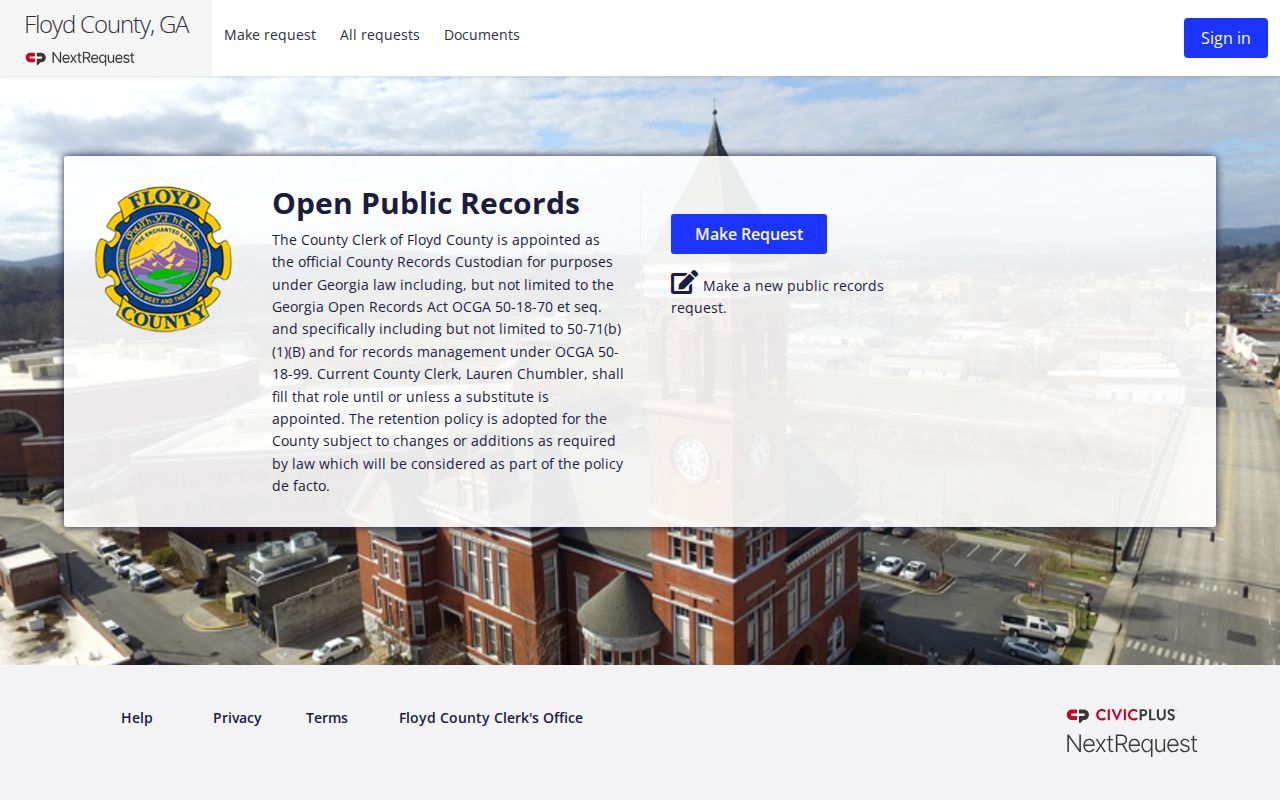
The portal's new-request form is represented in the second assigned view.
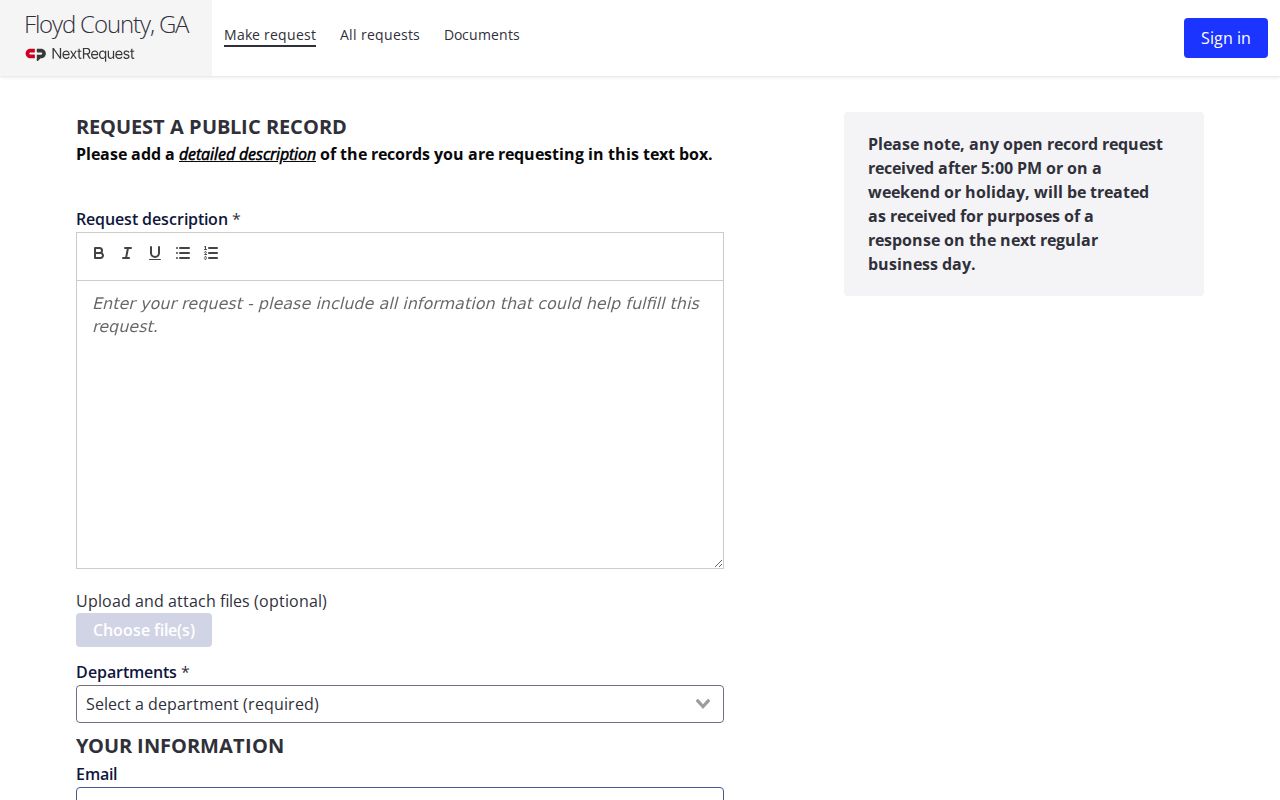
The custodian split matters when you write a request. Name the office, the date range, the record type, and the delivery format you want, so the receiving clerk can tell quickly whether the request landed in the right place.
City-by-City Court Dockets
Floyd County has two incorporated municipalities: Rome and Cave Spring. Each runs its own municipal route for city citations and ordinance matters. Rome offers municipal court, appearance, and payment pages. It also lists a vendor with limited enabled search methods. Cave Spring publishes a monthly court schedule and payment routes. There is no general public docket search there. Cases outside municipal jurisdiction move to the appropriate Floyd County court. They do not stay on the city docket.
Rome Court Records
2020 population 37,713 · Municipal citations, city violations, appearance rules, and eligible payment routes.
Cave Spring Court Records
2020 population 1,174 · First-Monday Municipal Court, City Hall records contact, and citation payment channels.
Map and Directions to the Floyd County Courthouse at Government Plaza
Superior Court records and the Clerk of Superior Court are kept at 3 Government Plaza, Suite 101, in downtown Rome. The same complex holds Magistrate Court in Suite 227 and Juvenile Court in Suite 202, so the suite number matters as much as the address. The third floor has the County Law Library, with a public computer terminal, printer, and LexisNexis access for research, though it is not the docket custodian.
Floyd Superior Court Clerk
3 Government Plaza, Suite 101
Rome, GA 30161
Mail: PO Box 1110, Rome, GA 30162
706-291-5190
Parking is limited: the courthouse lot enforces a one-hour limit, street parking on Tribune Street is capped at three hours, and the Third Avenue and Sixth Avenue decks are the practical fallback. Build in extra time for a clerk-counter visit, and check the emergency-order index before traveling, since winter-storm and courthouse-fire orders have both closed or affected Rome Circuit courthouse access in 2026.