
Floyd County Criminal Docket Searches
Begin at the Floyd public criminal interface. It splits searches into Superior Court and State Court categories. An All option covers both. You can enter a local case number, a name, an alias, a citation, or a system-wide term. Filed-from and filed-to dates work too. At least one criterion is required. Each text criterion needs three or more characters once the wildcard is excluded. So a very short surname can fail validation even when the screen itself works fine.
Use the most exact fact you have. A case number avoids false matches far better than a name. If all you have is a name, check the court category, the case header, and the event history. Do that before trusting the result. The portal asks searchers to click the plus sign beside a case number. That expands its docket.
- Choose criminal search and the likely Floyd County court category.
- Enter one reliable criterion with enough characters.
- Narrow a broad result with filing dates or a second verified field.
- Expand the matching case and read events in date order.
- Ask the proper clerk for the filed order when exact wording matters.
Floyd County Criminal Docket Fields
Treat the Floyd County criminal docket form's controls as filters, not proof. The form tells you which fields exist and how the search rules work. It cannot promise that every document image is free. Nor can it promise that any private case will open. What it does give you is a clear map. It covers the fields and the rules that govern them.
| Field | Best use | Limit |
|---|---|---|
| Case # | Exact known local file | No sample format was verified |
| Name or Alias | Participant search | Confirm identity from the header |
| Citation | Known citation reference | Court category still matters |
| Filed From / To | Date-range filter | Uses MM/DD/YYYY |
| Superior / State | Trial-court scope | State means State Court, not statewide |
The Floyd criminal search source shows this local form. Its State Court checkbox names a class of Georgia trial court, not a statewide docket search.
Criminal Dockets: What They Show
A Floyd County criminal court docket is an event history, not the whole case file. Read the case header first. Then sort court settings apart from filed acts and orders. Beyond the public interface and the official calendar labels, nothing more should be promised. No local number pattern or fixed schema applies.
| Case number | The court-assigned identifier, shown as a local case number until its exact Floyd format is confirmed. |
|---|---|
| Charge or filing | The recorded accusation or filed item; exact text belongs in the filed document. |
| Setting | A scheduled arraignment, plea, status, non-jury, calendar call, or other proceeding. |
| Order | A judge's filed direction, distinct from a motion asking for that result. |
| Disposition | The recorded procedural result, which should be checked against the judgment. |
A name hit alone proves nothing about identity. A calendar entry does not prove the hearing occurred, and an online gap does not prove the file lacks the document.
Floyd County Criminal Docket Labels
Floyd Superior judge pages publish several criminal calendar labels. The labels say why a case was set, never what happened. That matters. It keeps a plea calendar from being mistaken for a plea, and a calendar call from being mistaken for a trial.
- Arraignment calendar
- A setting for arraignment-related work.
- Plea calendar
- A plea-related setting, not proof that a plea was entered.
- Status calendar
- A review or update setting, not a disposition.
- Criminal non-jury
- A non-jury setting whose outcome must be read from the event or order.
- Peremptory calendar
- A firm scheduling or trial-related local label that must be read with its notice.
Calendar addenda can supplement an earlier posted list. Match the judge, division, date, and latest file label before relying on any Floyd County criminal setting.
Criminal Case Stages on the Docket
A felony case can pass through warrant, bond, indictment or accusation, arraignment, and pretrial motion practice. Later come plea or trial, disposition, sentencing, and still more activity. Not every case hits each stage. Lower-court events can also come before any Superior Court file appears. Floyd County Magistrate Court runs warrant applications, search warrants, first appearances, bonds, and preliminary hearings. It does so six days a week.
Docket flow: Filing › Arraignment › Pretrial › Plea or Trial › Disposition › Sentencing
The event description and the filed order control. An arrest is not a disposition. A set plea date is not a guilty plea. When precise terms matter, check a sentencing entry against the judgment.
Floyd County Criminal Docket Warrants
Some Floyd County criminal docket questions start below Superior Court. The official Floyd Magistrate Court page describes warrant, first-appearance, bond, preliminary-hearing, and deposit-account-fraud work. Its public case route leads to a login, so treat it as a gated route rather than an open search.
The linked official Floyd Magistrate Court source helps you spot the right lower-court path for these matters.
When the online route fails, call the Magistrate clerk. For a Superior criminal record, Mary Hardin Thornton, Clerk of Floyd Superior Court, holds the record. Her office sits at 3 Government Plaza, Suite 101, Rome. Mail goes to PO Box 1110, Rome, GA 30162. The phone number is 706-291-5190.
Give the exact court name, the case or citation number, the party spelling, and a date range when you call. Ask whether the item you want is a docket entry, a calendar setting, or a filed document. Each may use a different channel. If the matter began with a warrant or first appearance, ask whether it moved from Magistrate Court up to Superior Court. That transfer can explain why an older lower-court route and a newer felony docket show different stages of the same matter.
Floyd County Criminal Docket Courts
Georgia assigns criminal work by offense, age, and place. Floyd County Superior Court, in the Rome Judicial Circuit, holds exclusive constitutional authority over felonies. Georgia State Court generally handles misdemeanors, traffic, warrants, and preliminary criminal hearings. Magistrate Court takes early-stage matters and some ordinance cases. Rome and Cave Spring municipal courts keep their own city-limit traffic and ordinance records.
Juvenile Court handles delinquency and juvenile traffic. Those records run through confidential procedures. The public Floyd criminal form is no substitute for that court's lawful access process. If a search returns nothing, check jurisdiction and dates. Draw no conclusion before that.
Floyd County Juvenile Docket Limits
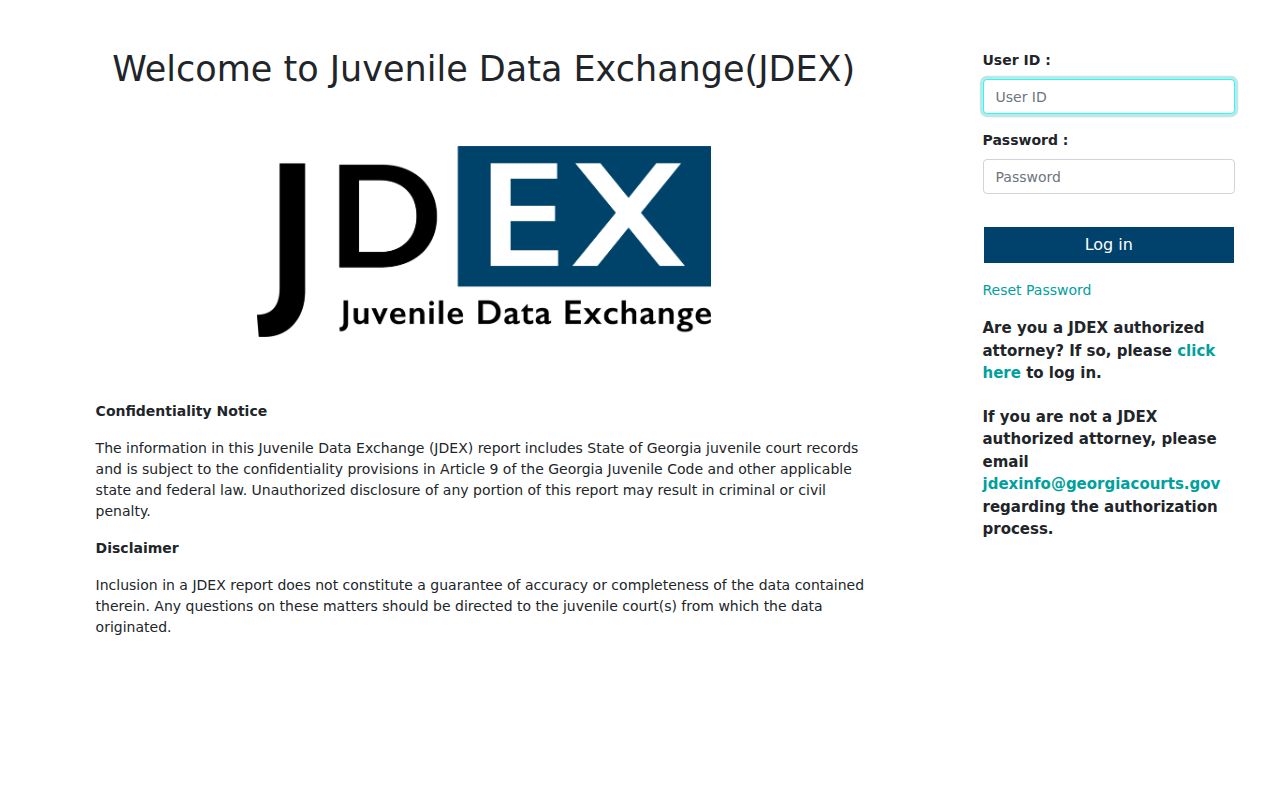
Juvenile matters sit outside the public docket in Floyd County. The court treats juvenile data as confidential. Georgia's JDEX system is restricted to attorneys. It is not an open criminal docket lookup. Anyone with a lawful reason to request a juvenile record can ask Juvenile Court directly. Ask about the proper process. The official Floyd Juvenile Court source explains this separate jurisdiction.
Why can't a missing public result settle whether a juvenile matter exists? Confidentiality often explains the gap, so an absent listing proves nothing about the case itself.
The JDEX login page draws a different line: it marks an account boundary, not open public access.
Work within the Floyd County court's own access rules for juvenile records, and skip any third-party site that promises to slip past the restriction.
Missing Floyd County Criminal Dockets
An empty Floyd County criminal docket search can happen for several reasons. The name you typed may be too short. The wrong court box might be checked. Beyond that, the filing may fall outside your date range, live in a municipal or Magistrate system instead, sit behind an account boundary, or be restricted by law or court order.
- Try a verified case or citation number.
- Use a longer exact name and adjust the filed-date range.
- Test court categories only as the facts support.
- Contact the clerk for the tribunal that handled the case.
- Request the filed document when the index lacks its full text.
Never read an online gap as proof of a sealed record. The Floyd County clerk can tell a simple search problem from a true legal limit on access.
Access Rules for Criminal Dockets
Public access comes first in Georgia Uniform Superior Court Rule 21. The rule then builds in limits where law or court procedure calls for them. Redaction gets its own treatment. It covers protected identifiers that must stay out of view. Juvenile files, sealed cases, protected family details, and orders tied to a specific case can all shrink what a Floyd County criminal docket shows the public.
The routes in differ. A local portal offers a public index for Floyd County court records. Georgia's E-Access directory sends Floyd Superior users to Tyler ResearchGA. It flags that an account is required. For questions, the Superior Clerk works the counter, mail, and phone. The office also handles copy requests for court records. One caution: a NextRequest filing with county administration is administrative, not a court-record request.
Key access rules:
Uniform Superior Court Rule 21 starts from public access but permits lawful restrictions and redaction.
Georgia Open Government guidance explains requests, copying, charges, and protected data.
Georgia JDEX guidance describes restricted attorney access to juvenile information.
Note: A docket entry only summarizes what happened. Confirm the event and the filing order with the Floyd County clerk before you rely on any criminal docket description.